Nature always has amazing gifts to offer to mankind and one such great wonder is Belum Caves, the largest cave system on plains of India, lying below agricultural fields. A walk down the caves truly takes one to a different world altogether... one that takes you towards the earth's crust.
REACHING THERE: Belum Caves is located in Kurnool district in the state of Andhra Pradesh in South India. The nearest major town in Tadpatri, from where the caves are around  35kms away. Tadpatri is also the nearest rail head and is located on the Chennai-Mumbai rail route. Other nearby towns to reach Belum caves would be Anantapur (90 kms away) and Kurnool town (110 kms away). The route from Tadpatri to Belum caves is good in parts, bad in parts and decent for the rest.
 35kms away. Tadpatri is also the nearest rail head and is located on the Chennai-Mumbai rail route. Other nearby towns to reach Belum caves would be Anantapur (90 kms away) and Kurnool town (110 kms away). The route from Tadpatri to Belum caves is good in parts, bad in parts and decent for the rest.
It is tough to miss out the entry to the caves. From afar, at least 5 kms away, you would be able to spot the name 'Belum Caves' painted on the hill top lying close to the cave system. Even, if you miss that, there is no way you would pass a blind eye over the huge statue of Buddha placed at the entrance to the caves. Statue of Buddha is not there without a good reason as the caves were once occupied by Buddhist monks.
 were once occupied by Buddhist monks.
BELUM CAVES: Belum caves is just about gaining prominence. Many have still not even heard of it. So, it definitely is a paradise unexplored. One of the three huge holes in the field serve as entry point to the cave. A nominal entry fee of Rs.40/- is charged. A descent of 15-20 steps takes you directly to the starting point of the cave. Being on the plains and involving limited physical efforts, it clearly is one cave that any one in the family, across ages, can reach and explore with ease.
Except a water bottle, one is not allowed to take any other belonging into the caves. There is a cloak room available outside the caves where belongings can be deposited. If you do not
 carry anything valuable, then you could just place your bags in the open lockers just besides the entry stair case. No eatables, including soft drinks are allowed. Apart from hygienic reasons to keep the caves litter-free, eatables are prohibited to avoid growth of bacteria inside the caves.
A group of visitors would be accompanied by a guide. These guides are made available by AP tourism and are free of cost. It is definitely worth to move through the caves alongside a guide, especially if it is your first visit. How to navigate and what to observe would be best known only to the guides. If you are a non-Telugu speaking visitor, you should be able to find a guide speaking either Hindi or English. So, language should not be a barrier here.
THE JOURNEY INSIDE: The caves is a complete natural formation of stalactites and stalagmites, essentially limestone formations. A walk through the caves completely could take up to 3 hours, especially if you have a camera at hand. The entire cave system is not an easy walk through. Although, it is not very tough to navigate, it could be physically exerting to some extent. One might have to pass through narrow openings, dark patches and a few rocky paths. Also, at several places, one essentially has to bend over to seep through. One also needs to be careful about rocky projections here and there along the path to make sure you do not bang into any of them.
 stalactites and stalagmites, essentially limestone formations. A walk through the caves completely could take up to 3 hours, especially if you have a camera at hand. The entire cave system is not an easy walk through. Although, it is not very tough to navigate, it could be physically exerting to some extent. One might have to pass through narrow openings, dark patches and a few rocky paths. Also, at several places, one essentially has to bend over to seep through. One also needs to be careful about rocky projections here and there along the path to make sure you do not bang into any of them.
All these might sound a bit scary. But, you can be rest assured it is not. These are all you would look forward to inside a cave and you do get it all at  Belum caves. The walk inside the caves is definitely feasible for the entire family. Being under the earth's crust with limited ventilation, be prepared to sweat profusely. Credit should go to AP tourism for placing ventilation ducts at strategic points inside the caves. After a bit of exertion, a whiff of air comes as a great relief inside the caves. The caves are also lit appropriately. It offers enough light to click a few pics and yet is dull enough to keep the exploration natural and exciting.
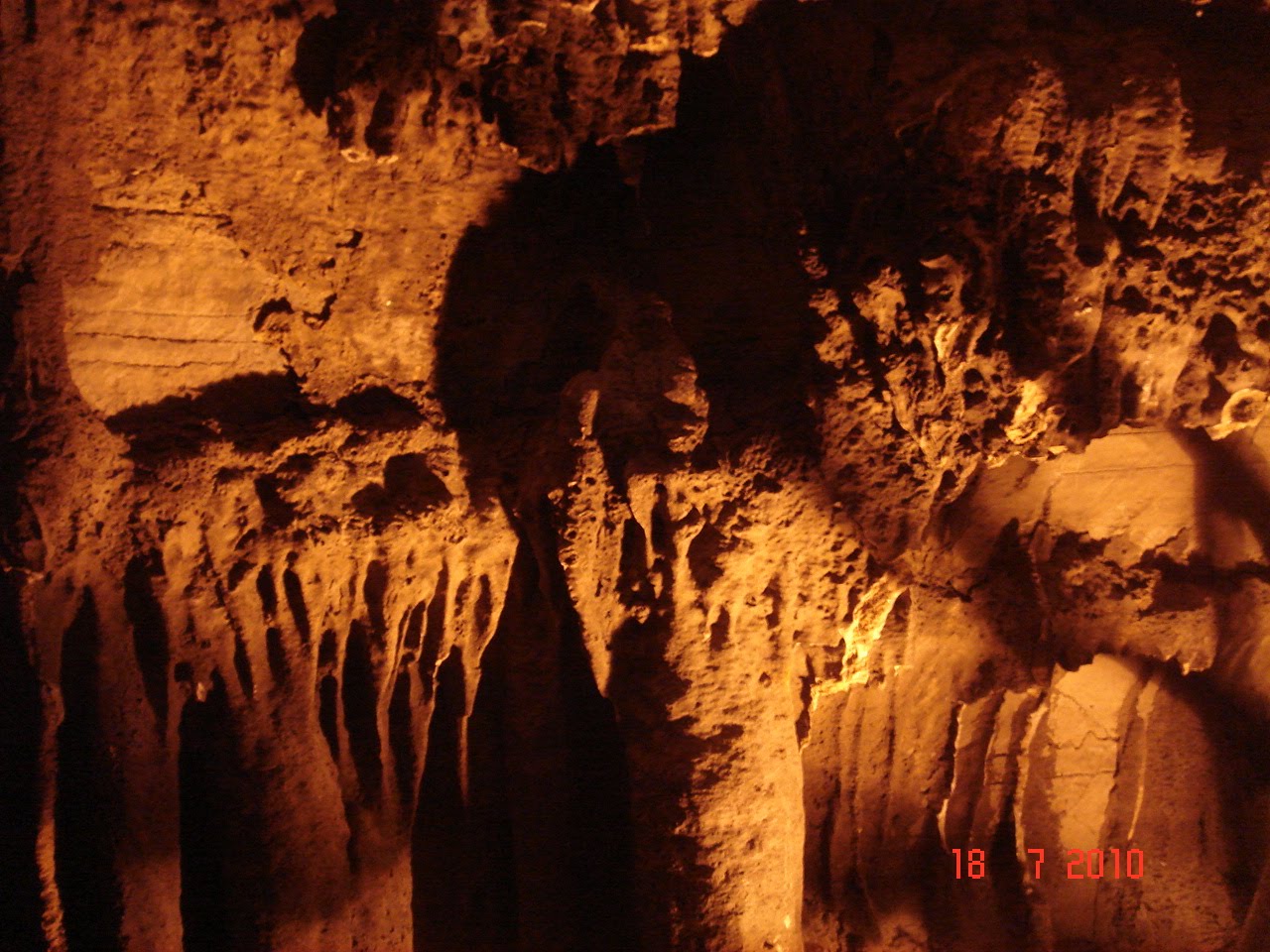 Belum caves. The walk inside the caves is definitely feasible for the entire family. Being under the earth's crust with limited ventilation, be prepared to sweat profusely. Credit should go to AP tourism for placing ventilation ducts at strategic points inside the caves. After a bit of exertion, a whiff of air comes as a great relief inside the caves. The caves are also lit appropriately. It offers enough light to click a few pics and yet is dull enough to keep the exploration natural and exciting.
IMAGINATIVE STRUCTURES: As you walk through, the guide would draw you attention to several interesting observation points inside the cave. Most of these would be structures formed by limestone that resembles a human or an animal or an object. All these are just figments of imagination,  but that makes the trip quite interesting. I am sure as you walk through you would discover new patterns and imaginative structures that the guide has not made a mention of.
 but that makes the trip quite interesting. I am sure as you walk through you would discover new patterns and imaginative structures that the guide has not made a mention of.
As I think through, there were several such very interesting structures we observed. The structure of a lion, a crocodile, a diwan, Lord Ganapathy, a five-hooded snake and India map to name a few. There were also certain earmarked locations. One among them was Kodi Lingam (meaning a crore lingas), where limestone formation on the roof of the caves would resemble a huge plethora of lingas. Then, there was Patala Ganga, the deepest point of the cave at around 150ft below ground level. There one can observe a natural formation of a linga with a narrow water stream below it.
 One other interesting observation is a place where stalactite and stalagmite (one emerging from the roof and the other from the floor) meet to form a pillar. Further, interestingly, while returning we were given an option of walking back the same way we had come or take an adventure route through a dim lit passage with mini rocks all over the ground. We took the adventure option and had to pretty much squat through the passage. That added to the excitement and gave a nice little finale to the trip.
ENDLESS CAVES: Belum cave system is also called locally the Endless cave as no one knows where the cave system ends. Only certain sections of the cave have been developed for tourists and certain sections earmarked for future developments. So, probably in future the caves would have lot more to offer.
 developments. So, probably in future the caves would have lot more to offer.
AMENITIES: While AP tourism should be credited for effective management of the caves, other amenities there requires a face lift. In specific, the restaurant facility is a big drawback. So, if you are planning a visit to Belum caves, it is better you carry food with you. After an exerting trip, I am sure you would want to have a happy meal, which unfortunately the place does not offer. There is also not a great hotel to stay near-by and one will have to halt in the near-by towns.
 ADDITIONAL NEAR-BY VISIT: Tadpatri has two very wonderful temples that is worth a look. Chintala Venkatramana temple and Bugga Ramalingeswara temple. Both are unique in their own ways and speaks volumes of the great craftsmanship of Indian sculptors in those days. If you are in specific interested in arts and sculpture, then these temples are a must visit. I would probably make a post on them soon. So watch out the blog space.
SCHEDULING YOUR TRIP: Anantapur is probably your best option for lodging overnight. So, if you do start from there, you could first cover the Tadpatri temples, probably visit Alur Ranganathaswamy temple and then push off to Belum caves. From here, you can proceed to Yaganti, the abode of Lord Uma Maheshwara and then to Nandyal, if you wish to make your next overnight halt or to Ahobilam to seek the blessings of Lord Narasimha.


