Showing posts with label Indian tourism. Show all posts

Tuesday, April 19, 2011

Temples in and around Salem - Part I

Just back from a temple tour around Salem. Did a lot of net search to arrive at the list of temples to cover. So, thought would be a good idea to put in at one-place list of possible temples to cover. Broadly there are three routes of coverage, one could plan from Salem: Salem and around, Salem - Namakkal and Salem-Tiruchengode route. I would thus like to make my blog post a three part-series. In the first part, I would cover temples in Salem and around Salem.

1. Raja Ganapathy Temple:It is located at 1st Agraharam, one of the primary market areas of the town and is always bustling. It is a good temple to start one's temple tour around the region. For the size of the outer structure of the temple, the statue of lord Ganesha inside is reasonable large in size and gives one a pleasant feel. This is a small but powerful temple located at the heart of Salem Town.

2. Sugavaneswarar Temple: This temple within Salem is dedicated to Lord Siva. It is a reasonably big temple and one of the primary landmarks of the town. The Siva is said to be a suyambu, meaning, to have come into existence on its own without anyone constructing it. In fact, this is one of the five temples around river kaveri in that region to have emerged on its own. The main linga is in a slightly slanted position. Lordess Swarnambikai is housed in a separate sanctum. There are shrines for other gods like Ganapathy, Muruga and Dakshinamoorthy too.

3. Kottai Mariamman Temple: Kottai Mariamman is believed to be the primary goddess protecting the town. Pilgrims and locals alike throng in big numbers to this temple. The goddess here is in the form of a small, beautiful looking statue and the sight is very pleasing to the eyes. Unlike in a typical Mariamman temple, at the feet of the lordess one would not find a skull or a devil, but rather just a lotus bud, making it quite unique.

4. Kottai Perumal Temple: Kottai Perumal temple is also located in the Kottai region of Salem. Kottai means Fort. When I visited the temple, there was some major renovation work at the temple and hence could not catch a complete glimpse of the gods here. Some of the statues were completely covered in cloth, while in certain other cases only part of the sanctum was open.

5. Ayodhiapattinam Ramar Temple: As the name of the town suggests, this is a temple dedicated to lord Rama. It is quite an old temple with wonderful sculptural works. It is about 10 kms from Salem on the eastern direction. The temple sanctum ceilings are filled with paintings depicting various mythological scenes, although it has got slightly eroded over time. The walls and pillars of the sanctum are beautifully decorated with intricate carvings and sculptures. Legend has it that given the delay in time for Rama to reach Ayodhya from Sri Lanka in time for his Pattabhisheka, Lord Rama had his pattabhisheka done at Ayodhiapattinam, when the good time was still available and later did it in Ayodhya with all necessary procedures. So, we find Rama and Sita in a sitting posture, which is generally not found in other temples.

Ram is seen here with his left leg folded and Sita Devi with her right leg folded. Also housed in the same sanctum are Lakshmana, Hanuman, Vaali and Vibishena. A look at the sanctum gives one a feel that one is actually witnessing a pattabhisheka. In general, we find Sita to be standing to the right side of Rama in most temples. However, here we will have Sita devi seated to the left of Rama as is done during Pattabhisheka.

6. Belur Thanthondreeswarar Temple: About 18kms from Ayodhiapattinam is Belur. Here, there is an historic, grand temple of Shiva with the name Thanthondreeswarar. It is said to have been built in the 12th century. Thanthondree means emerging on its own and as the name indicates, this is a suyambu linga. For a suyambu linga, one would be surprised by the relatively large size of the linga. The rajagopuram of the temple is quite an imposing one and is a 7-tier structure. The temple pillar carvings are also a wonderful work of art. The lordess is known by the name Dharma Samvardhini. One would also find a sanctum for Kalyana Ganapathy, which houses two Vinayaka statues within the same sanctum, one large and one slightly smaller one. People offer prayers here for early marriage of their children.

7. Tharamangalam Kailasanathar Temple: This is an historic old temple at Tharamangalam, about 30 kms from Salem. It is to the west of Salem and hence in the opposite direction to Ayodhiapattinam. This is a temple constructed by the Cholas and carries their typical architectural marks. Lord here assumes the name of Kailasanathar and Lordess is Abirami. The temple tower is an imposing structure but, we could not manage a glimpse of it, since it was completely covered for renovation work. The pillars and ceilings have wonderful stone carvings that one could admire all day long.

There are a couple of interesting features within the temple. The temple's inner walls carry sculptures of various gods, goddesses and sages equidistant from each other, in a variety of postures and displaying varied emotions. One could spend hours admiring the craftsmanship of each of these sculptures. Secondly, we have sculptures of Manmathan and Rathi, Indian god and goddess of love, staring benevolently at each other. This is said to be quite unique not found in any other temple. There is also a pathala linga here in the underground that can be reached by a series of few steps.

8. Omalur Chinna Tirupathi Temple: Omalur is about 10 kms from Taramangalam and from Omalur, the Chinna Tirupathi temple is about an other 10kms. There is one place called Chinna Tirupathi near Salem as well. So, make sure you do not land up at the wrong place. The temple is quite an old one, but has been significantly extended in recent years. So, at the outset the temple looks quite new. However, one can observe the contrast in new and old architecture when one enters the inner sanctum. As the name indicates, it is a temple dedicated to lord Vishnu. The lord here assumes the name of Prasanna Venkatesa Perumal.

REACHING SALEM: Salem is about 300 kms from Chennai. It is an important rail and road junction and is well connected. It is also easily accessible from Bangalore. It is the closest rail head for Yercaud, one of the hill stations in the region, commonly referred as Poor man's Ooty. The Salem town is famous for its steel plants, limestone mines and Mangoes. The town also has an airport where currently only a single flight plies to Chennai.

Thursday, September 2, 2010

Thimmama - Hosting the World's biggest tree

This is one wonder, which has definitely not got its share of credit. Thimmamma, located near Kadiri in South India is a wonder that India should be proud of. Unfortunately, not many are even aware of this place or what it stands for. To get to the matter straight, Thimmamma is the place that hosts the world's largest banyan tree and probably the world's largest tree as well.
REACHING THERE: Thimmamma is located at a distance of about 35 kms from Kadiri. Kadiri in turn is located at Anantapur district in Andhra Pradesh in South India. It is located at a distance of about 100 kms from Anantapur main city. Kadiri is also close to Puttaparthi, the abode of Satya Sai Baba. It is about 50 kms from Puttaparthi. The nearest major rail head would be Tadipatri (about 50kms from Anantapur) located on the Chennai-Mumbai rail route. The road from Kadiri is not so great and the directions/ signposts are also quite minimal.

ALL ABOUT THIMMAMMA: Thimmamma is the place that hosts the world's largest Banyan tree and very much possibly the world's largest tree. The tree is about 650 years old, but never bears a look of it. The tree very much looks fresh and could easily survive centuries. Now for its size: the tree has about 1200 branches and covers, not one or two, but 5 acres. Yes, you heard it right. A single tree covers 5 acres.

There is an old, rusted sign board that indicates the fact that this the world's largest banyan tree. In fact, it is tough to locate the board as it located at one distant corner near the entrance. This was certified as the world's largest banyan tree by the Guinness Book of World Records, way back in the late 80s.

There is a fenced entrance to the place. You cannot directly reach out and touch the tree. You go through a fenced path with the branches of the tree sprouting on both sides. It's a great sight to look at. On both sides till the horizon you would see a green patch and it's great to feel that all comes from a single tree. You do however get a chance to have a feel of some sub-branches of the tree and probably take a snap along with it to mark your presence at Thimmamma.

A digital camera can never capture the magnificent structure. You are bound to take a lot of pics hoping one of them at least would capture the splendour. Unfortunately, you are likely to end up disappointed. The best lens to capture the beauty would b your eyes.

There is a small temple dedicated to a lady, Thimmamma, who is believed to have planted the banyan tree. The place is also named after her. There is a folklore attached to Thimmamma and the place, about which you would find a brief description at the entrance to the temple.

Probably, you would just spend at most 1 hour at Thimmamma. But, having come here I am sure you would feel great that you have watched a natural wonder and a proud structure that has stood the test of times for centuries and at the same time, feel a bit sad that the place is yet to receive the recognition, it richly deserves.

ADDITIONAL NEAR-BY VISITS: There is a famous Lakshmi Narasimha temple at Kadiri which is definitely worth a visit. The statue of the lord here is said to sweat. One could visit Prashanti Nilayam, the abode of Satya Sai Baba, about 50 kms from Kadiri. Also, one could touch upon Lepakshi temple boasting brilliant architectural splendours, located 100 kms away from Kadiri. The statue of the Nandi bull here is said to be the largest in the world.

SCHEDULING YOUR TRIP: If you are coming down from Anantapur, you could start the day with a visit to Lepakshi, then proceed to Thimmamma, visit the Kadiri temple and then either return to Anantapur or proceed to Prashanthi Nilayam. One can adopt the same route, if one is coming in from Bangalore as well. Lepakshi is about 150 kms from Bangalore.

Friday, July 23, 2010

Belum Caves - Amazing work of Mother Nature

Nature always has amazing gifts to offer to mankind and one such great wonder is Belum Caves, the largest cave system on plains of India, lying below agricultural fields. A walk down the caves truly takes one to a different world altogether... one that takes you towards the earth's crust.

REACHING THERE: Belum Caves is located in Kurnool district in the state of Andhra Pradesh in South India. The nearest major town in Tadpatri, from where the caves are around 35kms away. Tadpatri is also the nearest rail head and is located on the Chennai-Mumbai rail route. Other nearby towns to reach Belum caves would be Anantapur (90 kms away) and Kurnool town (110 kms away). The route from Tadpatri to Belum caves is good in parts, bad in parts and decent for the rest.

It is tough to miss out the entry to the caves. From afar, at least 5 kms away, you would be able to spot the name 'Belum Caves' painted on the hill top lying close to the cave system. Even, if you miss that, there is no way you would pass a blind eye over the huge statue of Buddha placed at the entrance to the caves. Statue of Buddha is not there without a good reason as the caves were once occupied by Buddhist monks.

BELUM CAVES: Belum caves is just about gaining prominence. Many have still not even heard of it. So, it definitely is a paradise unexplored. One of the three huge holes in the field serve as entry point to the cave. A nominal entry fee of Rs.40/- is charged. A descent of 15-20 steps takes you directly to the starting point of the cave. Being on the plains and involving limited physical efforts, it clearly is one cave that any one in the family, across ages, can reach and explore with ease.

Except a water bottle, one is not allowed to take any other belonging into the caves. There is a cloak room available outside the caves where belongings can be deposited. If you do not carry anything valuable, then you could just place your bags in the open lockers just besides the entry stair case. No eatables, including soft drinks are allowed. Apart from hygienic reasons to keep the caves litter-free, eatables are prohibited to avoid growth of bacteria inside the caves.

A group of visitors would be accompanied by a guide. These guides are made available by AP tourism and are free of cost. It is definitely worth to move through the caves alongside a guide, especially if it is your first visit. How to navigate and what to observe would be best known only to the guides. If you are a non-Telugu speaking visitor, you should be able to find a guide speaking either Hindi or English. So, language should not be a barrier here.

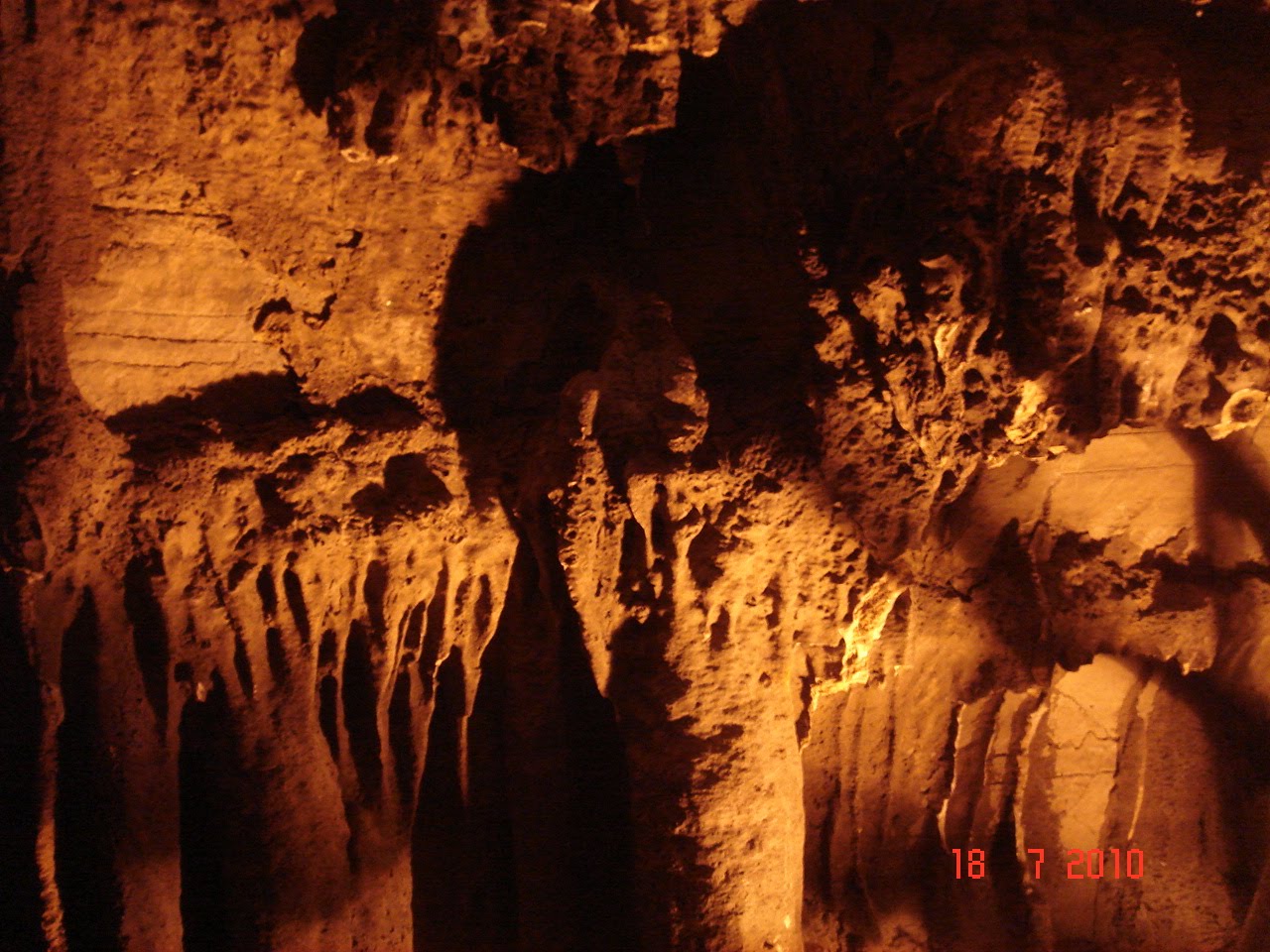
THE JOURNEY INSIDE: The caves is a complete natural formation of stalactites and stalagmites, essentially limestone formations. A walk through the caves completely could take up to 3 hours, especially if you have a camera at hand. The entire cave system is not an easy walk through. Although, it is not very tough to navigate, it could be physically exerting to some extent. One might have to pass through narrow openings, dark patches and a few rocky paths. Also, at several places, one essentially has to bend over to seep through. One also needs to be careful about rocky projections here and there along the path to make sure you do not bang into any of them.

All these might sound a bit scary. But, you can be rest assured it is not. These are all you would look forward to inside a cave and you do get it all at Belum caves. The walk inside the caves is definitely feasible for the entire family. Being under the earth's crust with limited ventilation, be prepared to sweat profusely. Credit should go to AP tourism for placing ventilation ducts at strategic points inside the caves. After a bit of exertion, a whiff of air comes as a great relief inside the caves. The caves are also lit appropriately. It offers enough light to click a few pics and yet is dull enough to keep the exploration natural and exciting.

IMAGINATIVE STRUCTURES: As you walk through, the guide would draw you attention to several interesting observation points inside the cave. Most of these would be structures formed by limestone that resembles a human or an animal or an object. All these are just figments of imagination, but that makes the trip quite interesting. I am sure as you walk through you would discover new patterns and imaginative structures that the guide has not made a mention of.

As I think through, there were several such very interesting structures we observed. The structure of a lion, a crocodile, a diwan, Lord Ganapathy, a five-hooded snake and India map to name a few. There were also certain earmarked locations. One among them was Kodi Lingam (meaning a crore lingas), where limestone formation on the roof of the caves would resemble a huge plethora of lingas. Then, there was Patala Ganga, the deepest point of the cave at around 150ft below ground level. There one can observe a natural formation of a linga with a narrow water stream below it.

One other interesting observation is a place where stalactite and stalagmite (one emerging from the roof and the other from the floor) meet to form a pillar. Further, interestingly, while returning we were given an option of walking back the same way we had come or take an adventure route through a dim lit passage with mini rocks all over the ground. We took the adventure option and had to pretty much squat through the passage. That added to the excitement and gave a nice little finale to the trip.

ENDLESS CAVES: Belum cave system is also called locally the Endless cave as no one knows where the cave system ends. Only certain sections of the cave have been developed for tourists and certain sections earmarked for future developments. So, probably in future the caves would have lot more to offer.

AMENITIES: While AP tourism should be credited for effective management of the caves, other amenities there requires a face lift. In specific, the restaurant facility is a big drawback. So, if you are planning a visit to Belum caves, it is better you carry food with you. After an exerting trip, I am sure you would want to have a happy meal, which unfortunately the place does not offer. There is also not a great hotel to stay near-by and one will have to halt in the near-by towns.

ADDITIONAL NEAR-BY VISIT: Tadpatri has two very wonderful temples that is worth a look. Chintala Venkatramana temple and Bugga Ramalingeswara temple. Both are unique in their own ways and speaks volumes of the great craftsmanship of Indian sculptors in those days. If you are in specific interested in arts and sculpture, then these temples are a must visit. I would probably make a post on them soon. So watch out the blog space.

SCHEDULING YOUR TRIP: Anantapur is probably your best option for lodging overnight. So, if you do start from there, you could first cover the Tadpatri temples, probably visit Alur Ranganathaswamy temple and then push off to Belum caves. From here, you can proceed to Yaganti, the abode of Lord Uma Maheshwara and then to Nandyal, if you wish to make your next overnight halt or to Ahobilam to seek the blessings of Lord Narasimha.

Sunday, June 20, 2010

Ellora and Ajanta Caves - Wonders that never cease to excite

Many would have visited the Ajanta and Ellora caves and I am sure there are many blog posts already on how amazing these caves are. I am not sure if this post adds much of a new information to what is available already. But, having visited the place recently, I want to document my amazing experience. So, here you go.

REACHING THERE: Ellora and Ajanta represent a series of caves in Maharashtra in Western India. The nearest town is Aurangabad. Aurangabad is relatively well connected with all major cities around Western India. It is located at a distance of around 215 kms from Pune and over 400 kms from Mumbai. Nashik, a famous religious town is also around 218 kms from Aurangabad. For more on Nashik, visit my previous blog post at http://travelwithguru.blogspot.com/2010/04/nashik-good-old-religious-town.html

Ellora caves are located at a distance of around 30 kms from Aurangabad. Ajanta is a further 100 kms from Ellora. Both these caves can be covered in a day from Aurangabad, provided you remind yourself that you would not spend too much time exploring the beauty of a single cave. It is definitely not without good reason that there are tourists spending a week at each of these wonderful caves to explore it in detail.

ELLORA CAVES: The sheer sight of the Ellora caves leaves you floored. The cave structure is so mighty extending over a significant landscape that you start to wonder where to begin. The signage which point to Cave 1-15 on to your right, Cave 16 straight ahead and Cave 17-36 to your left makes you feel all the more exciting. Yes, you heard it right. 36 caves collectively form the Ellora caves.

What is really intriguing is that the caves represent how well multiple religions thrived in the bygone era. Cave 1-12 belong to Buddhism, Cave 13-29 belong to Hinduism and Cave 30-36 belong to Jainism. But, what do these caves contain?... Well, Ellora is all about wonderful rock carvings. Each cave carries a treasure load of rock-cut sculptures that would leave you dazzled and speechless. These jewels seem to have been constructed over several centuries, some of them dating back to 6th century AD.

The biggest of them all is Cave 16, a monolithic Kailash temple, dedicated to Lord Shiva. The entire temple is supposed to have been carved out a single mountain rock by drilling holes right through. A simple carving out of a rock is by itself a real tough task and to have a full fledged temple carved out of a mountain is something well beyond imagination. How did the kings and craftsmen manage to achieve such a mammoth task in those days with hardly any technological advancement? How many people worked on this project? Who had the glorious vision to shape this wonderful piece of work? All these were some questions that crossed my mind as I kept staring at the entrance to Cave 16, the Kailash temple.

The entrance was gigantic in size, with among others, life size carvings of the 10 avatars of Lord Vishnu. Once you step inside, you are welcomed with huge statues of gods and goddesses. There is an intricately carved stone pillar on one side and gigantic elephant statue at the other end. To the left, is a two-storeyed cave with huge rock cut statues of goddess Lakshmi. The hall at the upper floor of the cave is huge in size with magnificently worked pillars. Straight on is a series of steps that take you to the sanctum of lord Kailash, an amazing linga. You could move around the sanctum of lord Kailash to find more sculptural wonders.

As you walk around the building of the Kailash temple, you would find the exterior walls filled with exquisite carvings depicting the story of Ramayana and Mahabaratha, apart from depicting numerous other gods and goddesses.

As you move ahead towards the other caves, you are filled with great wonders. We obviously did not have the time to explore all caves in detail. So, we had to take the help of the officials there to suggest us the best caves to visit. They suggested caves 14 and 21 among the Hindu caves. These caves had breathtaking carvings of Goddess Lakshmi and Lord Ganapathy apart from several other mythological characters.

Then, we proceeded towards the Buddhist caves, which had their own charm. The officials suggested not to miss Cave 10. The cave had a huge statue of sitting Buddha in self realisation posture. The hall was well decorated with intricate carvings and had a well-ornamented dome. Then, we visited a few other Buddhist caves that carried various postures of Buddha and images from Jathaka tales. Quite a few of the Buddhist caves were arranged in multiple storeys and most of them seemed to appear like a prayer hall.
The Jain caves from cave 30 to 36 are relatively smaller ones and we quickly covered all of them. Interesting ones among them being cave 30 and cave 32. Cave 30 too is a monolithic temple structure similar to the Kailash temple. Cave 32 is probably the most magnificent of the Jain caves with beautiful sculptures of Mahavir and Tirtankara.

AJANTA CAVES: After immersing ourselves in great architectural splendour at Ellora, we pushed off to the Ajanta caves. Unlike Ellora, your vehicle cannot directly take you to the caves. The caves are located inside the forest, where one cannot take his own vehicle. We need to alight at a particular point from where we are take to the foothills of the cave by a special bus. The journey takes about 20 minutes and is a very interesting ride. The jungle environment definitely adds to the excitement.

Once we descend from the bus, we need to do quite a bit of climbing up the hills to reach the caves. The pathway is a bit steep and long and may not be ideal for the faint hearted. But, once up there, one would realise all the pain was worth it. While Ellora was all about sculptures, Ajanta is all about wonderful mural arts. Unfortunately, unlike Ellora which have stood the test of times, Ajanta cave paintings have deteriorated over time and we see now are sadly only a few shades of masterstroke that still remain. However, having said that, the authorities are doing their best to keep the existing painting remains well-preserved.

Ajanta has a cave structure of 29 caves spread over a vast area. Most of the caves carry a strong Buddhist influence. The caves are supposed to have been excavated between 2nd century BC to 7th century AD and were primarily used by Buddhist monks. However, these caves had been almost forgotten over time, until a British hunter managed to discover them around the 19th century AD.

The first few caves appear to be in better shape compared to the later ones. In order to protect the images from further damage, the caves are mildly lit and flash photography is strictly prohibited. So, the only real way of capturing the beauty there was through my eyes. Although, a touch disappointing to see the murals in the disintegrated state, I could not help fantasising how they would have looked in full splendour. The guides in each of the caves are well knowledgeable and guide you to important aspects that needs to be noticed in the caves.

Overall, a visit to Ajanta and Ellora is architecturally a very rewarding experience and given an option, one should never miss this UNESCO World Heritage wonder.
ADDITIONAL NEAR-BY VISIT: When at Ellora, one should not miss a visit to Grishnesvara Temple. It is one of the 12 jyothirlingas dedicated to Lord Shiva and is located just a few kms away from the Ellora caves. The temple is constructed out of sandstone and has a wonderfully designed vimana that is worth many a clicks. The shiva linga inside is a small one where one could offer pooja directly with milk and flowers.

SCHEDULING YOUR TRIP: The best way to schedule your trip is to reach Aurangabad the night before. You could complete a visit to Nashik and Shirdi and could halt at Aurangabad. The next day, you should be well on time to cover Ajanta and Ellora.

Have a great trip!!!

Wednesday, January 27, 2010

Ilanji and Ayikudi - Twin Murugan temples around Tenkasi

Through this post, I introduce you to a couple of famous Murugan temples around Tenkasi, located in South Tamil Nadu. One is Ilanji and the other is Ayikudi. These are not extensive temples, being quite small in land area. Nevertheless, they carry their own charm and should not be missed, if you visit Tenkasi or the falls at Courtallam.

REACHING THERE: Both the temples are located around Tenkasi. If you are coming from Tirunelveli or Courtallam, you could visit Ilanji first, then visit the famous Tenkasi Viswanathar temple and could then proceed to Ayikudi. The nearest major town is Tenkasi which also has a rail head. Both the temples are located within 10 Kms range from Tenkasi, but in different directions. So, the best way to combine them is to visit in the order mentioned earlier.

ILANJI KUMARAN TEMPLE: Lord Muruga is known here in the name of Thiruvilanji Kumarar. The temple is located amidst a lush green locale and a mere visit to the temple surrounding is so pleasing. The temple is also rich in historical significance. It is believed that Courtaleeswar temple used to be a vaishnavite temple. Sage Agasthiyar was not allowed to enter the temple as he was a strong devotee of Shiva. The sage is said to have come to Ilanji and performed a penance. Lord Muruga, being the reigning god of the region, appeared before the sage and had asked him to visit the temple the following day, dressed as a vaishnavite.

It is also believed that Sage Agasthiyar also made two lingas out of white sand available in the region, which were then converged into one. This linga is found within the Ilanji Kumaran temple premise under the name Iruvulaga Nayagar (Lord of Two worlds, referring to the combination of two lingas). Since the linga is made out of sand, no abhishekams are performed to the linga. Lordess Parvati is known here as Iruvulaga Eeserkiniyal.

As you move around the temple premise, you can observe several tall trees and wonderful greenery, making it a great visual treat for your eyes. There are also shrines here for Kanni Vinayakar, Suriyan (Sun God) and Suradevar (God who is said to cure people with fever; suram in tamil stands for fever). Major lords of near-by temples like Courtaleswar, Tenkasi Viswanathar and Kuzhalvai Mozhi Ammal also have a shrine at Ilanji. Sage Agasthiyar also has a shrine here. The stala Vriksham (primary tree of existence) is Magizha maram.

AYIKUDI BALASUBRAMANYA TEMPLE: Here, Lord Muruga is known as Balasubramaniar. Here, you find a relatively small idol of Muruga in his younger days and hence aptly titled Bala Subramaniar. The temple architecture is very unlike a typical Murugan temple with the standard Tamil Nadu style of temple tower. Instead, it carries a Kerala style of architecture and even the temple practices have a Kerala touch to it. This is not surprising given its close proximity with the state.

Interestingly, there are five stala Vrikshams for this temple: Arasa maram, Vembu maram (neem), Kariveppilai maram, Madhalai maram and Maavilangu maram. Also, there is a small river besides the temple. The river is called Hanuman Nadhi. It is believed that Hanuman rested here for sometime before his journey to Lanka. Hence, the name for the river.

ADDITIONAL NEAR-BY VISITS: As mentioned earlier, when you visit these two Murugan temples, you pass through Tenkasi and the Viswanathar temple here should not be missed. The massive tower at the entrance is a great spectacle. Interestingly, apart from the exterior and interior sides of the tower being adorned with sculptures, even the sides of the temple tower here bear amazing work of art and one should definitely spend some time enjoying the beauty. The Tenkasi temple is reasonably huge in size with separate shrines for Kasi Viswanathar, Lordess Parvathi (known here as Ulagammai Nachiaar) and Lord Subramanya.

SCHEDULING YOUR TRIP: The best way to schedule your trip to Ilanji and Ayikudi is to connect it with other popular and interesting places around. This includes Tenkasi Viswanathar Temple, Courtallam Falls, Courtaleeswar temple and Chitra Sabhai. You could get greater insight about Courtallam and Chitra Sabhai from my old post:

Monday, January 11, 2010

Padmanabapuram Palace - The Royal Visit

Padmanabapuram palace is definitely one of its kind. The word palace immediately reminds one about grandeur, lavish decorations and wonderful works of art. Something along the lines of the Mysore Palace. However, Padmanabapuram palace was far off from it. It does not look massive at first glance with a single storey entrance. But the place definitely has its own charm.

REACHING THERE: Padmanabapuram palace is located at a place called Thuckalay, in Kanyakumari district in South Tamil Nadu. The nearest major town is Nagercoil, around 20 kms away. The palace is also close to Kerala and Trivandrum is just around 50 kms from here. The nearest rail heads include Kanyakumari, Nagercoil and Trivandrum.

HISTORY: Padmanabapuram palace belongs to the princely state of Travancore. Kanyakumari district was ruled by the Maharajah of Travancore in the pre-independence period. Post the state re-organisation, the palace came under the Kanyakumari district in Tamil Nadu. As you near the palace, you would definitely see a strong Kerala influence. Therefore, it is also not surprising to find the palace too bearing a strong kerala style of architecture. The palace alone is still owned by the Government of Kerala, although it stands in Tamil Nadu.

ENTRY AND TICKETS: An entry fee of Rs.25/- is charged per person. If you carry a camera with you, you might have to shell out an additional Rs.25/-. The Palace is open from 9 AM to around 6PM, with no intermittent breaks. The Palace is closed on Mondays.

THE PREMISE: The palace is quite different from the regular ones right from the entrance. As you enter the palace, you would observe a small one-storeyed building right in front of you. There is quite a large amount of open space in front of the main building with a small well-maintained garden.

As you enter the main hall, you would notice a huge verandah with some artefacts that were used by the erstwhile rulers. Each of the major halls within the palace have a guide who take you through the various interesting things about the hall and for what reason that particular room/area/building was used. At the main hall, one can three very interesting things: Oil lamp hanging from the ceiling, wonderful wooden ceiling and a bed.

The uniqueness of the oil lamp is that it can revolve 360 degree and once rotated upto a certain extent, it would stay still at the new position and would not reverse back to its original position. The wooden ceiling is another great piece of art. The ceiling consists of over 90 flowers carved out of wood and each one of them is unique. one is sure to miss out on this real uniqueness on the ceiling unless pointed out by the guide. The bed on display is quite interesting as it completely made of stone.

As we move to the first floor, we get to see the actual courtyard of the palace from where the king conducted his daily business. The size of the courtyard is not massive as is shown in movies, but definitely had the right appeal. The unique style of windows of the courtyard, that facilitates wind and sunlight to radiate across the place brought its own charm.

Then, we moved into the Dining complex. It is a two-floored complex. It was not the place where the nobles dined. But, it was used by the king to perform Anna Dhanam (free offering of food for the poor) daily. It is estimated that around 2000 people had food here everyday. The halls can definitely accommodate 2000 people and the thought of so many people having food here makes you feel excited.

Moving on, we reached the central building of the palace that is four-storeyed. The building had several interesting things worth mentioning: Ambari Mukam, the window through which the king viewed the public and addressed their grievances; Hall of paintings, that carried wonderful pictures portraying the king, his army, family, valour and philanthropy; Indira Vilasam, the guest room for important dignitaries visiting the king; Wonderfully crafted verandahs; Giant swings; larger than life mirrors and the list is endless.

One interesting aspect of the palace is its amazing complexity. We just went around the palace following the signboards and we never were really able to gauge how massive or how well-spread the palace was. Wondered who the architecture would have been?

We then proceeded to the King's chambers. Here, one can observe the bed used by the king. Apart from being supremely crafted, it is said that 64 herbs with medicinal properties were used in the construction of the cot, to keep the king away from any disease. One could also observe the bed on Queen mother as well as the weapon room. The Puja room of the king was kept out-of-bounds.

Our next stop was at the dancing floor, where supposedly various cultural programmes used to occur. There is a separate wooden dressing room for the artistes. Tamil movies like Varusham 16 and several Malayalam movies including His Highness Abdulla, is supposed to have been shot at Padmanabapuram palace. After looking at the dancing floor, I was able to quickly connect with these movies. There is also a small temple, a well as well as a kitchen for making food to be specially offered as Prasad.

Finally, we checked out the museum. It is well-maintained and one could see several artifacts found in the palace and items used by the king on display. Interesting among them were stone carvings marking significant events of the palace as well as wooden sculptures of gods. These sculptures are so akin to those made using stone and looked so new, despite each of them dating back to 10th and 11th century AD.

Overall, it is a wonderful experience not to be missed when you are in that part of the world.

ADDITIONAL NEAR-BY VISIT: Thirappu falls is located around 20 kms from the Padmanabapuram palace. One could give this a try. Alternatively, if you are coming from Kanyakumari, visit the Suchindram temple. It is one of the rare temples that has a shrine for the trinity of Brahma, Vishnu and Shiva together.

SCHEDULING YOUR TRIP: The best way to plan for a trip to Padmanabapuram palace, is to connect it along with a visit to Kanyakumari. You could view the sunrise at Kanyakumari, check out Suchindram and then push for Padmanabapuram palace. The palace visit is bound to take atleast 3 hours and you can then be back at Kanyakumari to catch up with the sunset.

Let the Royal journey begin!!!

Saturday, January 9, 2010

Manimutharu falls - Water at its pristine best

In this post, I take you back to Tamil Nadu to one of the truly beautiful manifestations of nature. Manimutharu is a wonderful waterfall in South Tamil Nadu and when in full flow, a great spectacle to have a look at or to drench yourself. It may not be as famous as Courtallam, not located far away from here, but that is what adds to the charm of the place. It is relatively untouched by the tourist population and is definitely not commercialised yet.


REACHING THERE: Manimutharu falls is located in Tirunelveli district in South Tamil Nadu. It is located at a distance of around 50 kms from Tirunelveli town. The nearest towns are Tirunelveli and Tenkasi (around 45 kms away) and both also are the nearest rail heads. The best means to reach Manimutharu falls is by road. The road from Tirunelveli is good, but bad in patches.

ENTRY TICKETS: There are two locations at which an entry ticket is charged. The ticket prices are reasonably nominal at around Rs.25/- per person. First ticket is issued by the local municipality. The falls come under the purview of reserve forest area and hence a ticket is issued for entering the forest. However, no prior permission is required to enter the forest up to the falls. There is a hill station called Manjolai located further up the hill, which requires prior approval.

THE FALLS: As soon as you pass through the forest entry point, you are suddenly thrown open to a huge lake and reservoir. With beautiful hills as backdrop, the sight is amazing and could easily qualify as one your lovely desktop wall papers.

The road is narrow and the slope is gradual with gentle meanders. The drive, with wonderful view of rocks on one side and the lake on the other side, is undoubtedly among the best drives I have had. This is one of those rides which you wish that it continues for a long time. To add to the joy, a gentle drizzle kept following us.

This drive continued for about 10 kms after which we were right at the foot of the falls. The very first sight of the falls, made me feel there was something special about the falls. It is for one, less crowded and we had pretty much the entire falls to ourselves and could easily click it from every viewpoint. Water was not really gushing in from a great height. At least, we were not really able to see the source of the falls from a great height. Our view was restricted to around just 12 feet.

What really made the falls special was for one, its width. The falls definitely looked massive. And second, was its force. It was really surprising to see the water gushing with such a force when it was not really high. Given the fact, we were not able to see much of the source of the falls, except the point from which it was pouring down, added to the excitement.

After enough long shots at the falls, I ventured closer. I was able to literally feel the pace of water flow by the sheer sound of the falls. It was such a pleasant sound that truly added to the thrill. There are special bays created for bathing and some change rooms are available close to the falls, although understandably not as well organised as at other prominent falls.

Water flow was not uniform. You suddenly see the force dropping a bit for a minute or two and then it would immediately pick up pace, larger than the initial level. All this made the falls all the more interesting to look at. After having spent close to an hour at the falls, with our hearts filled with great happiness and joy, we pushed forward. Even long after we left the vicinity of the falls, the sound of water kept reverberating in our ears.

TIME TO VISIT: The best time to visit the forest would be between the months of November and March, when the falls are in full swing. Also, since it is part of the reserve forest, entry is allowed only till 4PM and falls need to be vacated by around 5:30PM. Make it a point to visit early, so that you get enough time to enjoy the beauty at leisure.

ADDITIONAL NEAR-BY VISITS: The Agasthiar falls and the Papanasam Sivan temple are not far off from here and is definitely worth a visit. Further, if you are coming in from Tirunelveli, you would pass by two important towns: Pathamadai and Ambasamudram. Pathamadai is a well-recognised place for wooden mats and other wooden handicrafts. You will definitely find something interesting to shop here. Ambasamudram is known for its wonderful landscape and the Brahmadesam temple (about which I would post soon).

SCHEDULING YOUR TRIP: Tirunelveli is a great base for tours for all reasons. If you have a spiritual inclination or if you are a nature lover or some one who just want a mix of everything in your trip (more like me), then Tirunelveli could serve as a good base. You could start from Tirunelveli, complete a circuit of temples there and then cover Manimutharu falls and Papanasam and then proceed for Courtallam and Tenkasi. That will make it a truly great trip.
Catch up with Manimutharu falls before the tourist interest picks up in a big way.